Oakland's $1.39 Million Fix · Part 1 of 3: The problem.
In September 2020, the Archie Creek Fire burned more than 131,000 acres of Douglas County forest. Six years later, that fire is still showing up at Oakland's wastewater treatment plant.
Ash and sediment from burned hillsides wash into Calapooya Creek with every hard rain. Cleaning that dirtier water at the city's water plant produces a heavier stream of waste, and Oakland's small sewer plant has struggled to keep up.
The city's answer, for now, is a $1.39 million interim project paid for with federal disaster recovery money, more than half of all such money set aside for Douglas County. Most residents have never heard of it. In this three-part series, the Beacon explains the problem, the fix and the money behind it, and the questions still waiting for answers. Part 1 starts where the trouble started.
The fire
The Archie Creek Fire started the morning of Sept. 8, 2020, east of Glide in the North Umpqua River drainage, driven by a fierce east wind. It burned an estimated 72,000 acres in its first 12 hours and became the largest wildfire on record in Douglas County, at 131,542 acres. It destroyed 109 homes, most along Highway 138 East and Rock Creek Road.
The fire did not stay in the North Umpqua. The wind carried embers around the western edge of Mount Scott into the upper Calapooya Creek drainage, forcing evacuations east of Sutherlin, and crews later held containment lines along the South Fork of Calapooya Creek.
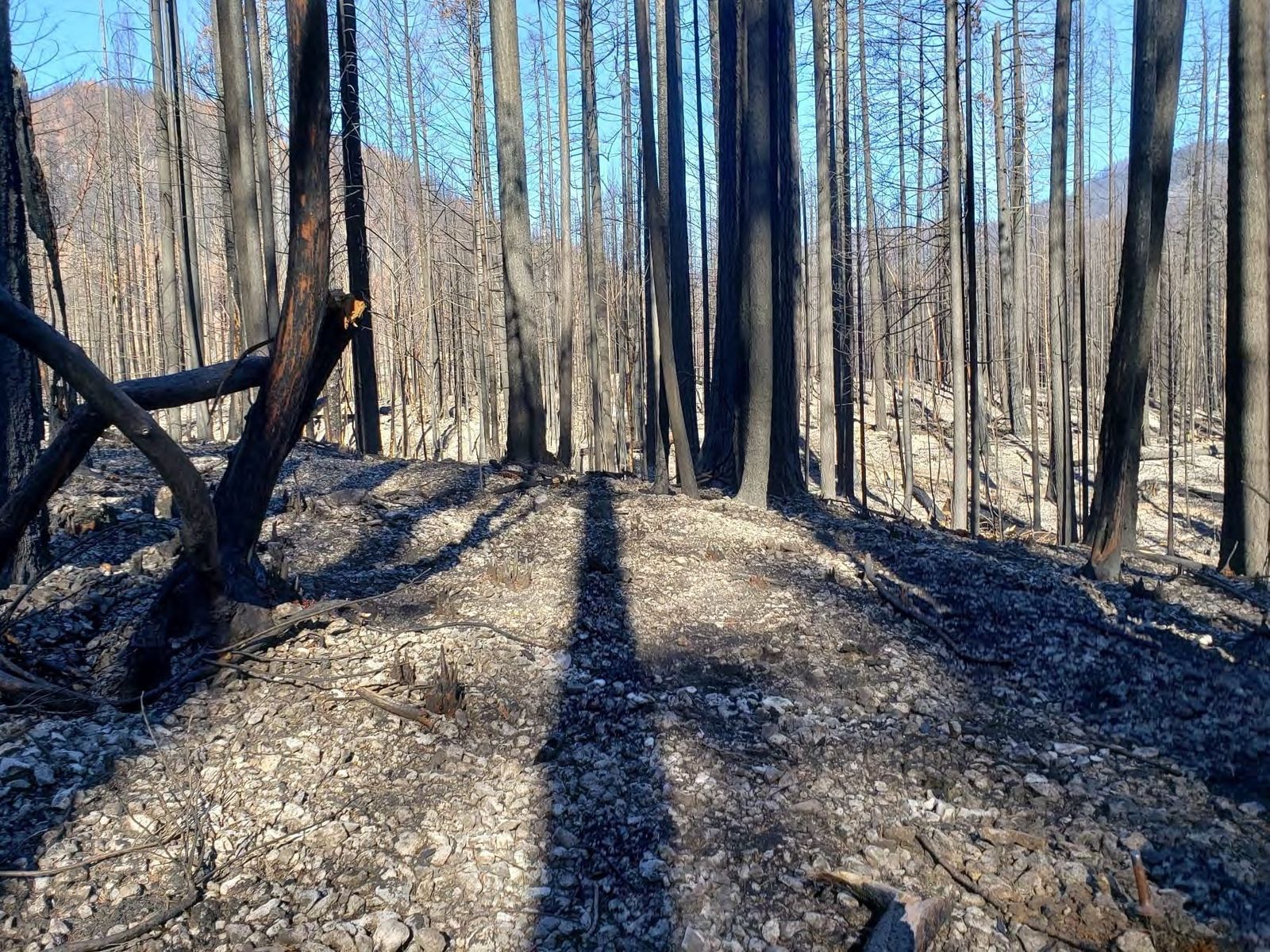
A soil burn severity report found that 77% of the fire burned at moderate or high intensity, leaving bare ground and, in the worst areas, ash several centimeters deep. Ground like that sheds ash and sediment into streams for years after the flames are out.
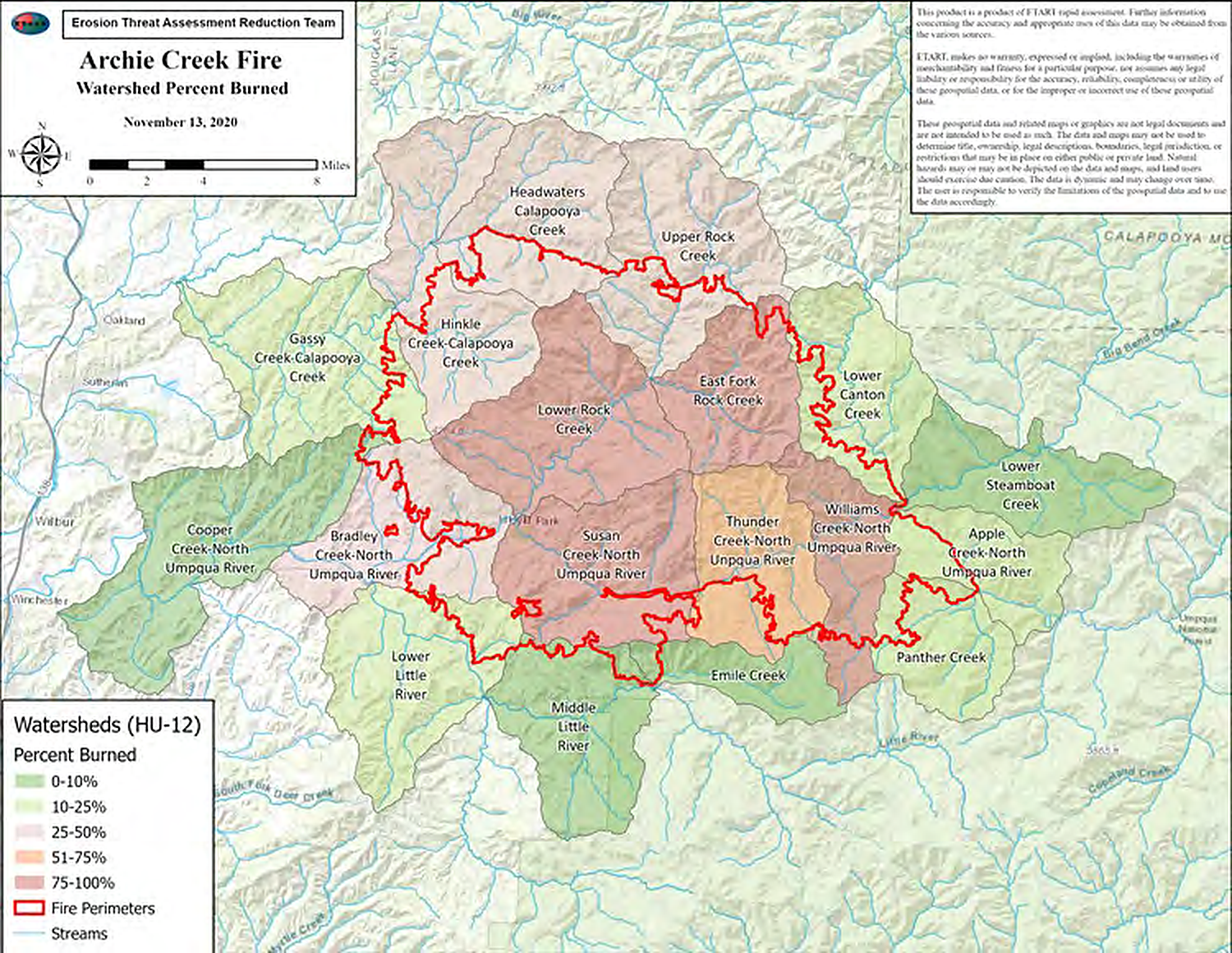
The Calapooya took a real share of that damage. A federal erosion assessment found that 27% of the Headwaters Calapooya Creek subwatershed burned, along with 49% of the Hinkle Creek–Calapooya Creek subwatershed and 10% of Gassy Creek–Calapooya Creek.
A 2020 state and federal review of drinking water systems downstream of the fires listed Oakland among those with no alternate water source. About 16% of the city's drinking water source area lay inside the fire, most of it private land with high erosion risk. Researchers who have sampled Hinkle Creek, a Calapooya tributary studied for years before the fire, report that nitrate levels have varied widely from stream to stream since the burn.
How a fire miles away reaches Oakland's sewer plant
The link between a forest fire and a sewer plant isn't obvious, so it's worth walking through.
Oakland's water treatment plant filters creek water before it reaches your tap. When the creek runs dirty with ash and sediment, the filters clog faster and have to be cleaned more often by flushing water backward through them, a process called backwash. That dirty rinse water goes to the city's wastewater treatment plant.
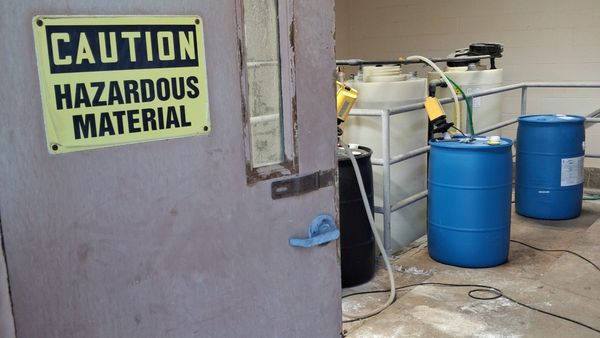
According to the state's project description, the extra load put the plant at risk of not meeting its permit standards and has caused excessive sludge, higher chemical costs and electrical problems. Douglas County Board Chair Tim Freeman made the same point when commissioners approved the grant in October 2025: the sewer plant itself wasn't burned, but the runoff passing through it is damaging the inside of the plant.
The permanent cure lies upstream, at the water plant, where the backwash begins. That fix has not yet been engineered and could take a decade to design and build, with FEMA committed to backing it. Until then, FEMA is covering the water plant's extra fire-related operating costs.
Meanwhile, the sewer plant will keep taking the brunt for years. The PIER project is an interim solution there, meant to keep the plant's discharge within its DEQ permit until the permanent fix arrives.
What went wrong at the water plant
The trouble showed up within weeks. In November 2020, an Oregon Health Authority record noted that Oakland's water plant was struggling to treat water because of ash and manganese, and that its ultraviolet disinfection unit was falling short because the tubes and sensors were coated with manganese and ash.
The city's February 2024 application for PIER money, obtained by the Beacon, describes a problem that has only grown. It says a 2023 study by the Horsley Witten Group, funded by the U.S. Environmental Protection Agency, tied changes in Calapooya Creek's water after the fire to ongoing damage at both the water and sewer plants. According to the application:
- Bacteria that thrive on iron and manganese, along with algae, have taken hold in the filters, tanks and reservoirs. They absorb chlorine, coat sensors and optical equipment with black slime, and load the filters with debris.
- Summer creek water running warm and winter flow problems have led to state drinking water exceedances.
- The city described itself as in "perpetual administrative violation by default," because the fouled equipment obstructs required reporting.
FEMA has opened a project, known as PW605, to define and pay for permanent repairs. An engineering firm, HBH Consulting Engineers, is scoping that work through 2026, with design and construction to follow in separate phases. The application says FEMA has estimated a system-wide fix could reach $15 million.
The 2023 study itself has not been made public. The Beacon has requested a copy.
Update, Oct. 13, 2026: Since this story was published, Public Works Director Jim Hart provided the Beacon with the 2023 Horsley Witten Group study cited above. The study examined Oakland’s water treatment plant, where it traced post-fire problems to iron and manganese trapped in the plant’s filters. It did not examine or document damage at the city’s wastewater treatment plant; that link was described in the city’s 2024 grant application. Part 2 of this series reports the study’s findings in detail.
Coming next
Part 2 explains the two fixes, the permanent one at the water plant and the interim PIER project at the sewer plant, and where the money for each comes from. Part 3 looks at the questions still facing the project, after the City Council takes it up again Oct. 20.
Disclosure: The Calapooya Beacon's editorial board submitted written questions on this project to the City Council before its Oct. 6 meeting. Beacon Editor Wayne Harger spoke at that meeting, and has separately addressed the council as a resident about the pellet mill discharge.
Sources:
- City of Oakland, PIER Program Project Application, Feb. 27, 2024.
- Oregon Health Authority, Drinking Water Services contact report for the City of Oakland, Nov. 17, 2020.
- Erosion Threat Assessment/Reduction Team, Water Quality/Drinking Water Supply Resource Report and Archie Creek Fire Summary Report, 2020.
- University of Colorado Hydrosciences program, Hinkle Creek post-fire stream water study abstract.
- Oregon Housing and Community Services, "Oakland Wastewater Treatment Plant Rehabilitation" PIER project page.
- KLCC, "City of Oakland secures grant to repair water system stressed from 2020 wildfires," Oct. 9, 2025.
- The News-Review, "Archie Creek Fire was an entirely different monster," 2020.