Oakland's $1.39 Million Fix · Part 3 of 3: The payoff and the risks
Oakland's $1.39 Million Fix
Part 1: Six Years Later, the Archie Creek Fire Is Still Reaching Oakland
Part 2: A $1.39 Million Stopgap, and a Bigger Repair Years Away
Part 3: Racing a Deadline: What Oakland's Sewer Plant Upgrade Buys, and What Could Go Wrong
In Parts 1 and 2, the Beacon traced how the 2020 Archie Creek Fire still burdens Oakland's water and sewer plants, and how a $1.39 million federal grant would pay for new equipment at the sewer plant, separate from a larger FEMA-backed repair at the water plant. Part 3 looks at how the city proposes to build it, what the City Council heard Oct. 20, what the upgrade would buy, and the risks, with answers from Oakland Mayor Bette Keehley in an Oct. 28 interview.
How the city proposes to build it
Normally a city finishes the design, puts the whole job out to bid and hires the lowest bidder. The city's consulting engineer, Loree Pryce of Engineering Support Services, says there isn't time for that: the UV system and disk filter need state Department of Environmental Quality (DEQ) approval, equipment takes about nine months to arrive, and the grant requires the work to be finished by Jan. 1, 2028.
She recommends two steps instead:
- The city buys the main equipment directly, through two requests for proposals. Suppliers would be ranked on references, maintenance and support, not on price alone. Her memo estimates $158,330 for the headworks screen, $55,505 for the UV system and $187,420 for the disk filter, the last two if ordered by the end of this year.
- A single design-build contract, with one team both designing and building, installs everything: the concrete pad, piping, any pumps needed, and building changes. About $617,745 would remain for that work after the equipment is bought.
Engineering Support Services would manage construction as the city's representative. Pryce says having one team responsible from start to finish may also reduce costly change orders.
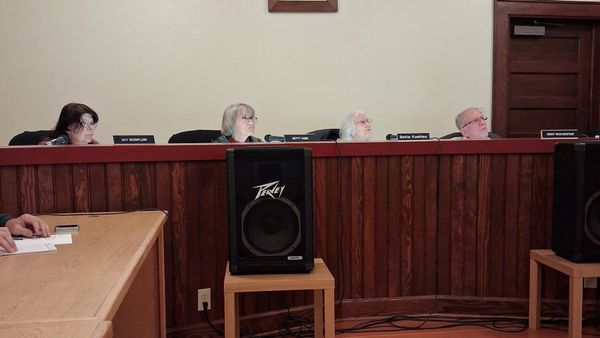
Pryce made the case again at a special council meeting Oct. 20. She said the proposal had been advertised in the Daily Journal of Commerce, opening a public comment period, and that the city attorney had made small changes to the findings. She objected to the legal term for what the city is seeking, an exemption from competitive bidding. "Design-build is competitive," she said. "It doesn't necessarily have to be the lowest price, but it is advertised, and there is competition." The usual sequence of design, DEQ review, bidding and council approval would take too long, she said, while design-build fixes a guaranteed maximum price within the budget. Keehley noted that the council, sitting as the city's local contract review board, has the final say.
Where things stand
The project is in its design phase. Pryce told the City Council on Oct. 6 that the federally required environmental review was completed in August, and her memo that night said the PIER funding agency had approved the design-build approach. On Oct. 20, Pryce said she had taken the approach to Oregon Housing and Community Services before presenting it, and the agency had not objected. But Public Works Director Jim Hart told the council the agency had emailed that evening, just before the meeting, saying it wanted to look at the approach in more detail. The agency must approve it with its legal team, Hart said, and agree to a budget that matches the project's timeline.
The draft findings Pryce presented Oct. 20 for the council to adopt, after small changes by the city attorney, are more cautious than her Oct. 6 memo. They say Oregon Housing and Community Services gave only an "initial assessment" and that the agency's compliance team sent comments Oct. 6. The project team, they say, "will continue to work with OHCS for their approval for all procurement methods." The agenda listed the item for council review only.
As of Oct. 6, the project was running behind the state's posted timeline, which called for design and DEQ approvals by Sept. 1, 2026 and construction bidding in November. Pryce's memo indicated the technical paperwork for DEQ was still to be submitted.
On Oct. 6, the council was asked to authorize the two-step approach. Pryce told councilors her memo was not meant as the legal mechanism for approving a design-build contract, and that she would return with a formal proposal and answers to written questions from The Calapooya Beacon's editorial board. The council voted unanimously to take the matter up again Oct. 20.
On Oct. 20, the council heard Pryce's findings as information only and took no action. The Beacon editorial board's written questions did not come up. The contracting decision is expected at the council's Nov. 3 meeting.
Even a Nov. 3 vote may not be the last word. In an Oct. 15 email to the Beacon, Hart wrote that "the Council vote to proceed means nothing until the process has been outlined and approved by the City Attorney." The state housing agency's lawyers, a federal compliance review and Douglas County must also approve it, "as they are the Recipient of the Grant not the City of Oakland." Once all of those parties agree in writing, Hart wrote, "the City will vote to proceed or not proceed."
Two dates frame everything that follows: the grant's Jan. 1, 2028 completion deadline, and the state's February 2029 deadline to draw all ReOregon money from HUD.
Two projects, not one
The PIER project at the sewer plant and FEMA's repair at the water plant are separate projects, paid for and carried out separately. FEMA's permanent repair covers only the water plant, where the fire did its direct damage. FEMA will not pay for work at the sewer plant, whose troubles are an indirect result of the fire.
It wasn't always planned that way. The city's 2024 PIER application sought money mainly as the local match for a combined repair of both plants, and said FEMA's tentative repair plan "includes extra equipment at the wastewater treatment plant." That combined approach fell through, Keehley said. "FEMA will not be associated," she said. Fixing the water plant should ease the load on the sewer plant, but the two projects won't share money or work, and the city now keeps a separate account for each grant.
FEMA's water plant repair is still alive. Keehley said FEMA sent the city an $800,000 check, a lump sum to cover its emergency operating costs to date and some still to come, ending the monthly reporting those payments required. Pryce is now under contract for the design work on the permanent water plant fix, as well as for the PIER project. Hart confirmed in an Oct. 14 email to the Beacon that the FEMA project remains open, with 2036 as the rough target for the permanent fix.
What the upgrade buys
The PIER equipment is meant to pay off at the sewer plant as soon as it's running, whatever happens at the water plant.
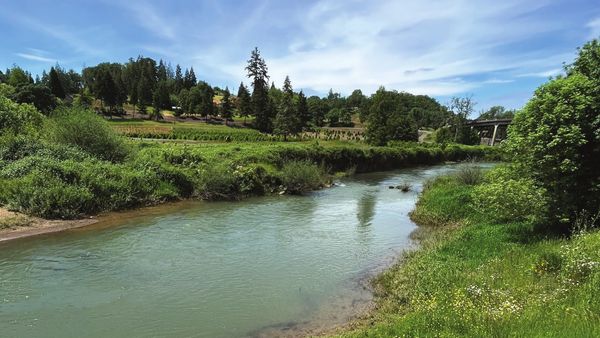
Cleaner water out the pipe. Together, the headworks screen, disk filter and UV system will raise the treated water leaving the plant from "Class 3" to "Class 1," a higher grade of discharge into Calapooya Creek, according to the state's project description. Cleaner water also opens the door to reusing it. Hart has told the Beacon he hopes to use it to water Stearns Park in summer, next door to the sewer plant, instead of drawing on the water plant. The idea isn't new: the city's 2024 call for engineers listed an irrigation system to spread the upgraded sewer plant water on land, and sprinklers for two city parks. Under Oregon rules, recycled water used on parks and playgrounds must meet the state's Class A standard, and any reuse requires a plan approved by DEQ.
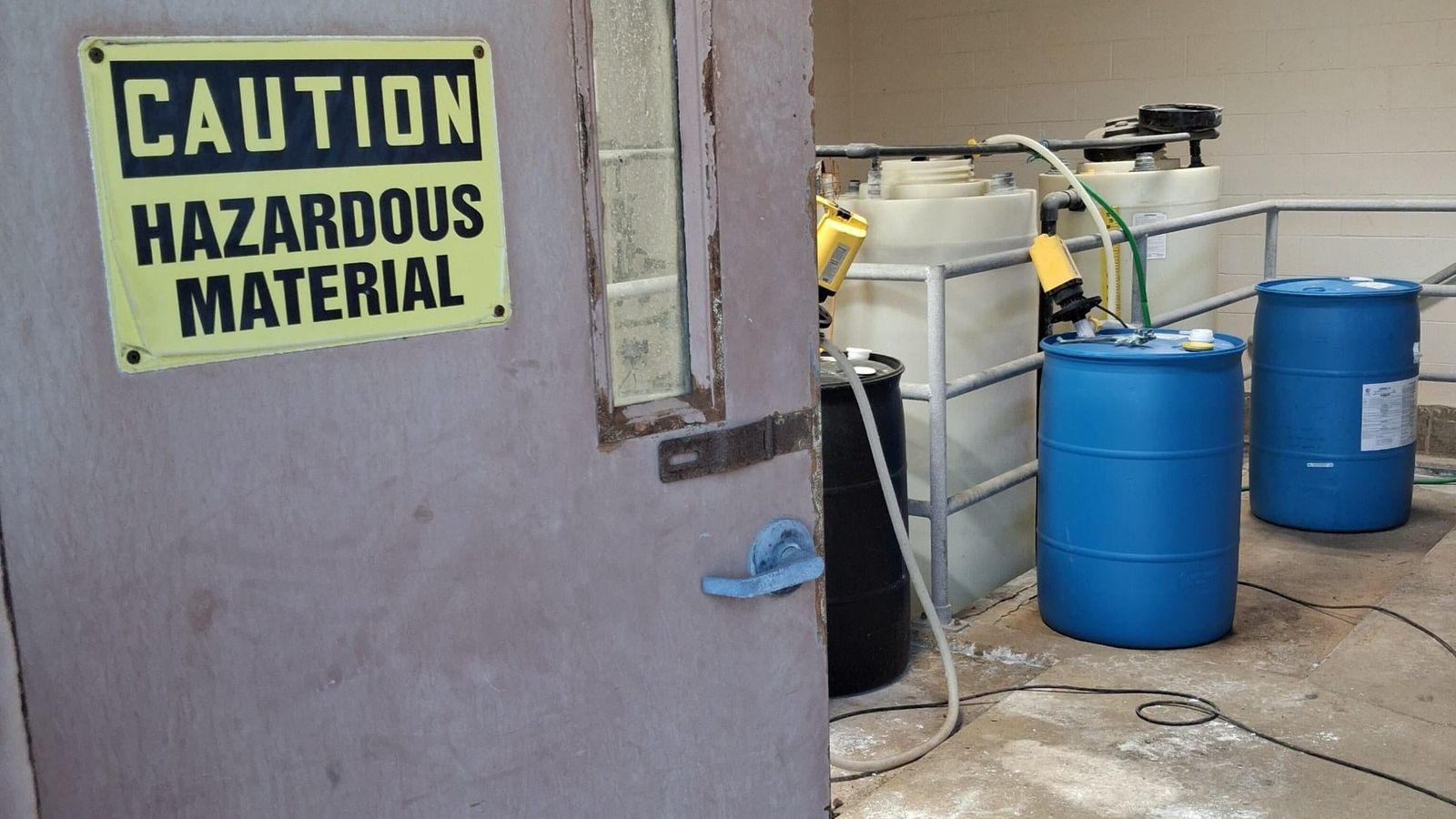
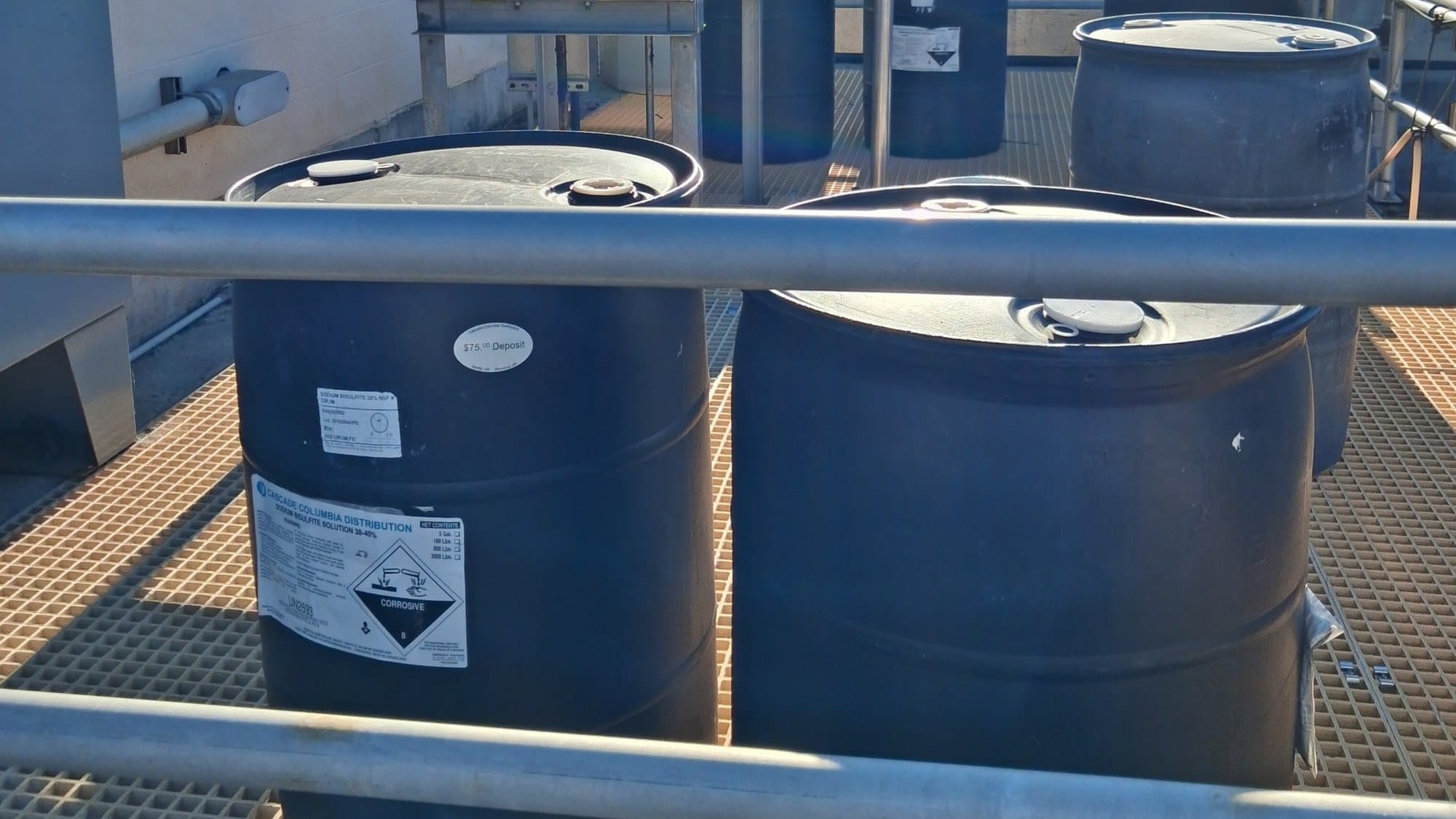
Lower operating costs. The UV system replaces the plant's chlorine disinfection, whose chemical costs climbed after the fire. "This should, in the end, cut some of our costs," Keehley said. The city hasn't yet put a figure on the savings, or on what the new equipment will cost to run.
Less strain on the plant. The headworks screen catches solids and debris as wastewater enters the plant. Keehley said the sewer plant's original bar screen, meant to do that job, "hardly ever worked," and that crews had to haul debris out of the plant's wet well by hand, in five-gallon buckets on a pulley.
Paid with grant money. The work is paid for with federal recovery money, not sewer rates, as long as costs stay within the grant. Douglas County will pay vendors directly, so the city won't have to front the money. "We're gonna get an invoice and send it to them. We're not going to pay it," Keehley said.
The risks, and the city's answers
The main risk is simple: can the city get the work done, on time and within the grant? That comes down to two cost questions. What will the city pay directly if the work gets done? And what will it pay if it doesn't?
The Beacon sent its questions to Hart on Oct. 27. Keehley, who handles media requests for the council, answered them in an interview at City Hall the next day. Keehley is a candidate in the contested Nov. 3 mayoral election; the Beacon interviewed her as mayor, about city business only. Her answers follow each question below.
- If the work isn't done in time. If equipment is ordered in December and takes nine months, it arrives around September 2027, leaving about three months to install, test and win DEQ sign-off before Jan. 1, 2028. The draft findings, though, say the equipment would be bought "in early 2027," which would push delivery closer to the deadline. The city's own 2024 application expected construction to run into 2029, past the program's 2028 close-out. Asked Oct. 20 whether the timeline could be extended, Hart said that for now the state agency is holding the city to it and won't budge unless something goes wrong, and that even then, extensions tend to come in small pieces. He said the head of the agency told him it has so much invested that "it's highly unlikely they would back out." Keehley put it plainly: "It's a drop dead deadline, and if we don't use the money, it's gone. They'll take it back." Still open: if the work isn't finished, what would the city already have spent that the grant wouldn't cover?
- If it costs more than planned. The budget has no contingency, and it is already tight. After the equipment is bought, about $617,745 is left for the design-build work, while the engineer's estimate runs $600,000 to $640,000. The high end would exceed what's left by about $22,000. Pryce's memo also says the UV and disk filter prices hold only if they are ordered by the end of this year. Asked Oct. 20 by resident Ron Pike whether an overrun could raise taxes, Pryce said a guaranteed maximum price in the contract is meant to remove that uncertainty, and that the city has also applied for additional funding in case of an overrun. Hart said Douglas County would support the city if costs run over. Keehley said design-build "locks in the costs for the equipment and for the actual project itself," and that the city won't go ahead without the money: "We're not going to start it if we can't do it." The county "will stand behind us," she said, "but they're not going to foot a bill, a big bill." And she said the city "would not saddle this city with any more higher fees from water and wastewater by going out on a limb on something like this." Still open: what the county has committed to, and whether it's in writing.
- Contracting rules. Oregon law generally requires a council to adopt formal findings, after a noticed public hearing, before skipping traditional competitive bidding. Pryce presented draft findings Oct. 20, which the council has not yet adopted, and said the proposal had been advertised statewide, opening a public comment period. The council is expected to act Nov. 3. Federal rules attached to this money also limit how contractors can be chosen, and the proposal would give extra weight to bidders with experience at Oakland's plant. Hart's September report says he held discussions with CDBG officials on procurement methods. His Oct. 15 email says the city attorney, state lawyers, a federal compliance review and the county must all sign off on the process, and on Oct. 20 he said the state agency wanted a closer look. Asked whether Nov. 3 will include a public hearing, Keehley first said there "probably won't be a hearing," then said she believed the city recorder had scheduled one. The Nov. 3 packet was not yet out. "The council will always have final say on anything," she said. Still open: whether Nov. 3 includes the hearing, and what the outside agencies have been asked to approve.
- One firm, many roles. Under the proposal, Pryce's firm, Engineering Support Services, would help write the request for proposals, assist with scoring them, serve as the city's owner's representative and manage construction. The draft findings note that her firm would not itself be under a design-build contract. Keehley said the city relies on Pryce "because she's affordable for us," adding, "She's always proved to be very, very good." Asked who oversees her for the city, Keehley said, "Well, Jim does, and I do." Pryce is a contractor, not a city employee, and reports to them every week, sometimes more often, Keehley said.
- Will the new UV system foul too? The 2023 study found that manganese-laden slime fouled the water plant's UV unit for years, to the point that the state advised boil-water notices whenever it failed. What will keep the same thing from happening to new UV equipment at the sewer plant, which receives the water plant's backwash?
- Does the fix match the study? The city's 2023 federally funded study, by the Horsley Witten Group, traced the post-fire trouble to iron and manganese trapped in the water plant's filters. It recommended replacing that filter media and adding engineered pre-chlorination there. It did not document damage at the sewer plant. The city's 2024 call for engineers describes the study more broadly. It says the study "determined an exact correlation" between post-fire changes in the creek and "ongoing damages" at the water plant, the wastewater plant, the recycle holding pond and the collection system. The study itself calls its findings "evidence supporting the theory" that the black residue came from fire-borne iron and manganese, and recommends more testing. It mentions the sewer plant only in citing a 2021 HBH Consulting Engineers analysis of possible impacts, which the Beacon has requested from the city. Keehley said that in 2021 the trouble was volume. Wet years, plus a water plant backwashing "every 10 minutes" after the fire, sent so much water to the sewer plant "that we couldn't process it." The fix planned then, a second holding basin at the water plant to store backwash before it goes to the sewer plant, is part of the FEMA design work, she said. Still open: what the HBH analysis shows.
One more question has a firm answer. As Pryce told the council Oct. 6, the project has nothing to do with the pellet mill's industrial discharge into the city sewer.
What's next
The City Council is expected to decide on the design-build approach at its regular meeting Tuesday, Nov. 3, at 7 p.m. at Oakland City Hall, 637 NE Locust St. Residents can attend in person, or request a Zoom link from the City Recorder at (541) 459-4531 at least 48 hours ahead. The Beacon will report on what the council decides.
Even if the council approves the approach, Hart says a final vote to proceed will come only after the city attorney, the state, federal reviewers and the county agree in writing.
The Beacon has filed a public records request with the city for the 2021 HBH Consulting Engineers analysis of fire impacts on the wastewater treatment plant, and will report what it shows.
Update, Nov. 4, 2026: The city has provided the 2021 HBH document the Beacon requested. It is a request for technical assistance, the scope of work that led to the 2023 Horsley Witten study, rather than a test-based analysis. It lists problems at the sewer plant in summer 2021: more sludge to haul, oxygen-starved conditions in a process built to run on oxygen, extra alum and chlorine, concerns about treated water then spray-irrigated in summer, added staff work, extra biological seeding, and mechanical wear from changes in water chemistry. It says those changes “directly affect the ability” of the plant to meet its state discharge permit, especially in November, while noting the conditions had not been formally verified.
Disclosure: The Calapooya Beacon's editorial board submitted written questions on this project to the City Council before its Oct. 6 meeting. Beacon Editor Wayne Harger spoke at that meeting, and has separately addressed the council as a resident about the pellet mill discharge.
Sources:
- Engineering Support Services memo to the Oakland City Council, Oct. 6, 2026, and the council meeting that night.
- Mayor Bette Keehley, interview with The Calapooya Beacon, Oct. 28, 2026.
- City of Oakland, agenda packet for the Oct. 20, 2026 special council meeting, including the draft findings prepared by Engineering Support Services for exempting the project from competitive bidding.
- The Calapooya Beacon, "Council sets December burn week, approves biochar workshop, holds off on PIER contracting," Oct. 20, 2026, and the meeting's audio recording.
- City Recorder Carolyn Shields, email on the Nov. 3 council agenda, Oct. 21, 2026.
- Horsley Witten Group, "Drinking Water and Watershed Evaluation, City of Oakland, Oregon," final report to EPA Region 10, June 21, 2023.
- City of Oakland, "Request for Qualifications: Water and Wastewater Wildfire Recovery Project – Phase 1 R2," 2024. Provided by the city.
- Jim Hart, Oakland Public Works Director, email to The Calapooya Beacon, Oct. 15, 2026.
- Jim Hart, Oakland Public Works Director, email to The Calapooya Beacon, Oct. 14, 2026.
- City of Oakland, PIER Program Project Application, Feb. 27, 2024.
- Oregon Housing and Community Services, "Oakland Wastewater Treatment Plant Rehabilitation" PIER project page.
- Oregon Health Authority, Drinking Water Services contact report for the City of Oakland, Nov. 17, 2020.
- Oakland Public Works Report, September 2026, and City of Oakland budget reports.