Clarification, Oct. 31, 2026: The FEMA repair at the water plant and the PIER project at the sewer plant are separate projects with separate funding. FEMA will not pay for work at the sewer plant, and the new sewer plant equipment is expected to stay in service after the water plant is repaired. An earlier city proposal to combine the two did not go forward. See Part 3 for details.
Oakland's $1.39 Million Fix · Part 2 of 3: The fix and the money
Oakland's $1.39 Million Fix
Part 1: Six Years Later, the Archie Creek Fire Is Still Reaching Oakland
Part 2: A $1.39 Million Stopgap, and a Bigger Repair Years Away
Part 3: Racing a Deadline: What Oakland's Sewer Plant Upgrade Buys, and What Could Go Wrong
In Part 1, the Beacon traced how ash and sediment from the 2020 Archie Creek Fire still reach Oakland: through Calapooya Creek to the water plant, and from there, as filter backwash, to the sewer plant. Part 2 looks at the two fixes, and where the money for each comes from.
Two fixes, two timelines
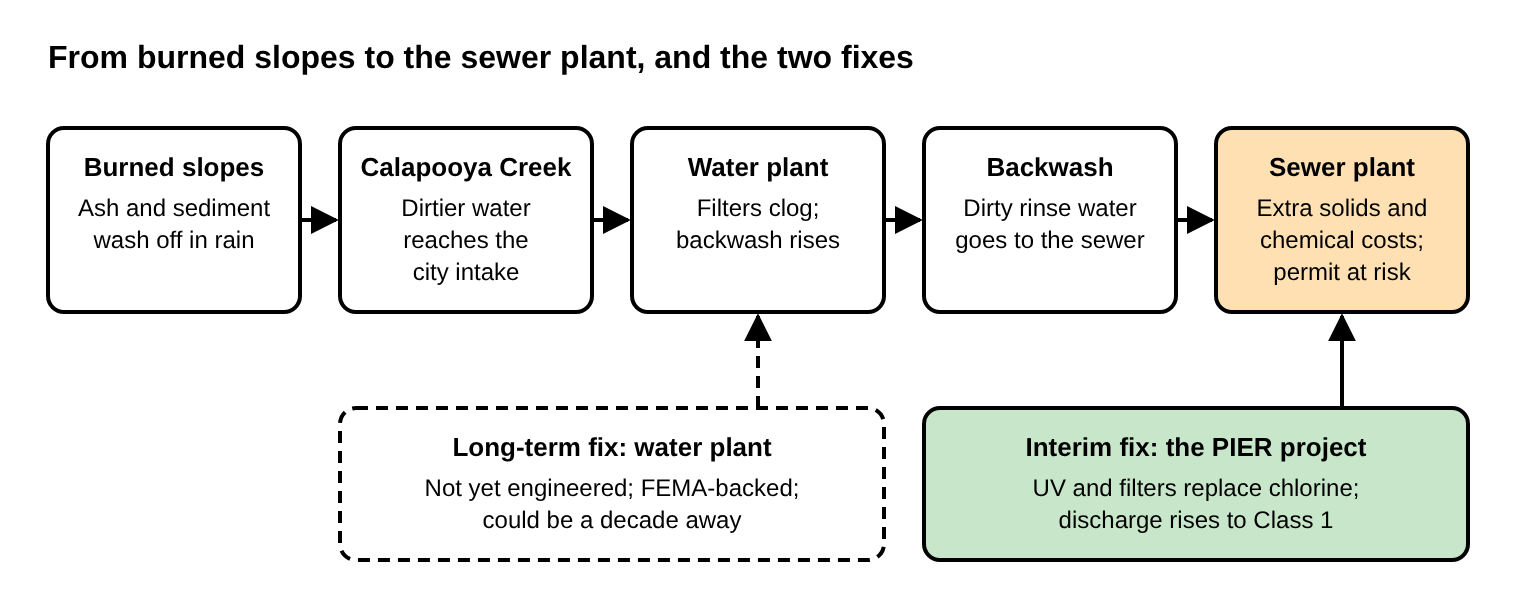
The permanent cure lies upstream, at the water plant, where the backwash begins. That fix has not yet been engineered and could take a decade to design and build, with FEMA committed to backing it. Until then, FEMA is covering the water plant's extra fire-related operating costs.
A 2023 study shows why the cure belongs there. The report, by the Horsley Witten Group for the U.S. Environmental Protection Agency and paid for by FEMA, was provided to the Beacon by Public Works Director Jim Hart. It traced the water plant's trouble to iron and manganese washed down Calapooya Creek in the rains during and just after the fire. Those metals lodged in the plant's filters, where manganese-eating bacteria then took hold and began shedding a black slime that coated the ultraviolet disinfection unit and the plant's sensors.
The consequences were serious. Because the fouled UV unit could not be shown to work, the study says, the plant fell out of compliance with state drinking water rules, and the Oregon Health Authority advised the city to issue boil-water advisories whenever the unit failed. The study found little or no iron or manganese in creek water by 2022; the problem now lies mainly inside the plant. It recommended replacing the filter media, adding an engineered system to chlorinate water before it reaches the filters, and treating for algae that bloom in the creek during hot, low-water summers.
That matches what federal and state scientists expected right after the fire. A December 2020 report by the Archie Creek Fire's Erosion Threat Assessment/Reduction Team, prepared for FEMA, found that large parts of some headwater subwatersheds had burned, as Part 1 reported. Across the whole Calapooya Creek drainage above Oakland, though, only about 3.5% burned at high severity. The team's modeling showed about a 10% rise in flood peaks at Oakland, so the post-fire flood risk to the city's water system was "unlikely to be elevated." The team did warn of "periods of very high turbidity affecting drinking water treatment." It added that water quality "normally returns to pre-burn levels within 1-2 years following fire."
FEMA has opened a project, known as PW605, to define and pay for those permanent repairs. An engineering firm, HBH Consulting Engineers, is scoping the work through 2026, with design and construction to follow in separate phases. According to the city's February 2024 application for PIER money, FEMA has estimated a system-wide fix could reach $15 million.
A 2024 call for engineers shows how broad a repair the city has in mind. In that request for qualifications, the second round, with proposals due July 17, 2024, the city asked firms to scope and price everything needed to return its water and sewer systems "to their pre-disaster condition."
The request's list of suggested work at the water plant includes new filters and UV reactors, cleaning of the clear well and both reservoirs, and a sludge drying bed. It also lists a new control system for both plants, nearly 470 wireless water meters, a new 1- or 2-million-gallon reservoir on Old Town Loop, and sprinklers to spread water on city parks. At the sewer plant, it lists disc filters and UV or ozone systems to reach Class 1 discharge, a holding pond, and irrigation to apply the treated water to land. Those are the same kinds of equipment the PIER grant now pays for. The request also calls for 25 studies and plans, including water and sewer rate studies.
Meanwhile, the sewer plant will keep taking the brunt for years. The PIER project is an interim solution there, meant to keep the plant's discharge within its DEQ permit until the permanent fix arrives.
What the PIER project buys
The project adds three pieces of equipment to the wastewater plant:
- A headworks screen, which catches solids as wastewater first enters the plant.
- A disk filter, which strains fine particles out of the treated water.
- Ultraviolet (UV) disinfection, which uses light to kill bacteria in the treated water before it leaves the plant.
The UV system replaces the plant's chlorine disinfection, whose chemical costs climbed after the fire. The state's project description says the upgrades will restore the plant to its pre-disaster condition and raise the treated water leaving the plant from "Class 3" to "Class 1," a higher grade of discharge.
Where the money comes from
After the 2020 Labor Day fires, the federal Department of Housing and Urban Development awarded Oregon $422,286,000 in disaster recovery block grants, known as CDBG-DR. Oregon Housing and Community Services runs the money under the name ReOregon. Most of it goes to housing. A smaller program, PIER (Planning, Infrastructure, and Economic Revitalization), gives each hard-hit county money for infrastructure and local recovery projects.
Douglas County's PIER share is $2,399,446. Each project had to be at least $500,000, and a county selection committee chose among letters of interest submitted in late 2023. Oakland's wastewater project, budgeted at $1,386,669.75, took about 58% of the county's share. County commissioners signed off in October 2025. Douglas County holds the grant, and county finance staff administer it.
This kind of money comes with federal strings. It is meant to be funding of last resort, after insurance and other aid. It is subject to federal rules on how contracts are awarded. And the state must draw all of it from HUD by February 2029.
Oakland originally asked for more. The city's 2024 application sought $1.85 million in PIER money, mostly to cover the local share FEMA requires, toward a combined $8.6 million effort across the water plant, distribution system, reservoirs, sewer plant and holding pond. What the state approved is $1.39 million, for work at the wastewater plant alone.
The city's case rested partly on affordability. The application says some water customers in the urban growth boundary already pay more than $300 a month, that about 14% of Oakland households live below the poverty level, and that passing disaster costs on to ratepayers would be inequitable.
What it costs, and what Oakland gets
The approved budget, as listed in the Oct. 6 memo from the city's consulting engineer, Loree Pryce of Engineering Support Services:
| Item | Budget |
|---|---|
| Construction | $1,099,000.00 |
| Planning and design, including DEQ approvals | $150,000.00 |
| Construction management and labor compliance | $50,000.00 |
| Douglas County finance staff (grant administration) | $46,338.14 |
| City project administrator | $24,000.00 |
| Pre-construction (land acquisition, permits) | $15,000.00 |
| Inspections (building permit) | $2,250.00 |
| Total | $1,386,588.14 |
The state's project page lists $1,386,669.75, a difference of $81.61.
Other costs. Not every cost shows up on a budget line:
- Staff time from a small city crew already stretched thin.
- Construction work inside an operating sewer plant.
- A tight schedule with little room for delay.
- No contingency line in the budget if bids come in high.
The benefits:
- A plant better able to handle the water plant's backwash during the years before the permanent fix arrives.
- Better odds of meeting the plant's state discharge permit, and of avoiding DEQ enforcement.
- Cleaner, better-disinfected water returning to Calapooya Creek.
- Relief from costs the backwash has driven up, such as sludge disposal. Public Works Director Jim Hart reported Oct. 6 that the city's sludge hauler is raising its price from 18 to 23 cents a gallon.
- Paid for with federal recovery money rather than local sewer rates, as long as costs stay within the grant.
Coming next
Part 3 looks at how the city proposes to build the project, the deadline it faces, and the questions still waiting for answers, after the City Council takes it up again Oct. 20.
Disclosure: The Calapooya Beacon's editorial board submitted written questions on this project to the City Council before its Oct. 6 meeting. Beacon Editor Wayne Harger spoke at that meeting, and has separately addressed the council as a resident about the pellet mill discharge.
Sources:
- Horsley Witten Group, "Drinking Water and Watershed Evaluation, City of Oakland, Oregon," final report to EPA Region 10, June 21, 2023.
- Erosion Threat Assessment/Reduction Team, "Archie Creek Fire ETART Extended Report," DR-4562-OR, December 2020. Provided by the city.
- City of Oakland, "Request for Qualifications: Water and Wastewater Wildfire Recovery Project – Phase 1 R2," 2024. Provided by the city.
- City of Oakland, PIER Program Project Application, Feb. 27, 2024.
- Engineering Support Services memo to the Oakland City Council, Oct. 6, 2026, and the council meeting that night.
- Oregon Housing and Community Services, "Oakland Wastewater Treatment Plant Rehabilitation" PIER project page.
- Douglas County PIER Disaster Recovery Grant Program flier, 2023.
- KLCC, "City of Oakland secures grant to repair water system stressed from 2020 wildfires," Oct. 9, 2025.
- Oakland Public Works Report, September 2026.